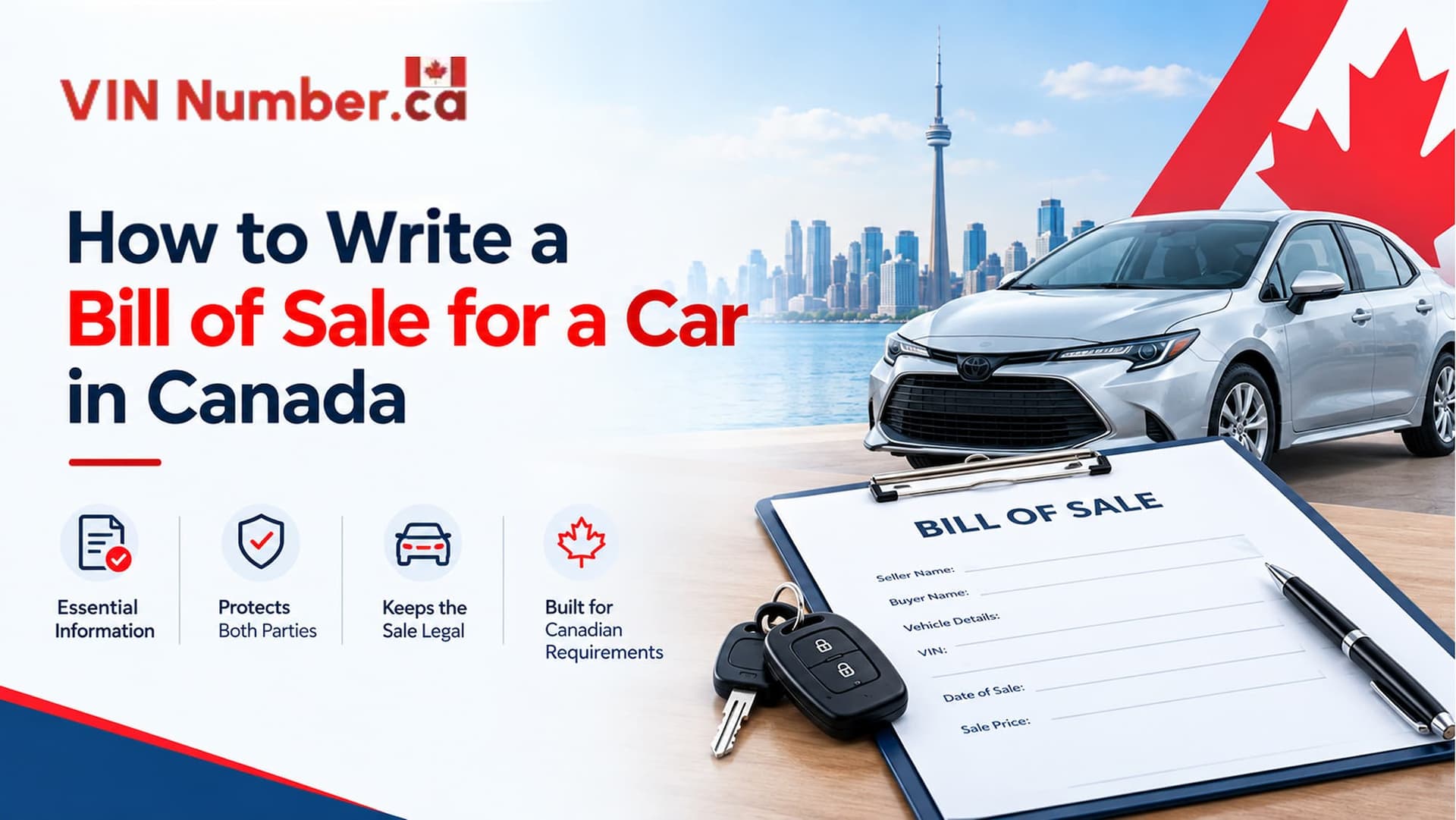
A bill of sale is a legal document that records a private vehicle sale between a buyer and a seller, which people often use for high-value or registered personal property, including Motor vehicles, motorcycles, and RVs.
This guide covers what a bill of sale needs to include, how the requirements shift between provinces, and where a bill of sale ends and a proper pre-purchase check begins.
Key Takeaways
- A bill of sale is an important record of a private vehicle transaction, documenting who sold and bought the vehicle, what was sold, and the agreed price.
- Requirements and supporting documents differ by province, so sellers and buyers should follow the rules of their provincial registry or transportation authority.
- Before signing, both parties should check the VIN and vehicle details against the vehicle and registration documents.
What is a Bill of Sale?
A bill of sale is a written record of a vehicle transaction. It shows who bought and sold the vehicle, identifies the vehicle, and records the agreed price. Both parties can keep a signed copy as proof of the sale if questions come up later.
A bill of sale is different from a title or ownership document. It shows that the sale took place, while the title or registration records ownership, depending on the province.
What Information Should a Canadian Vehicle Bill of Sale Include?
Although requirements differ across Canada, a vehicle bill of sale will generally identify the people involved, the vehicle, and the terms of the transaction.
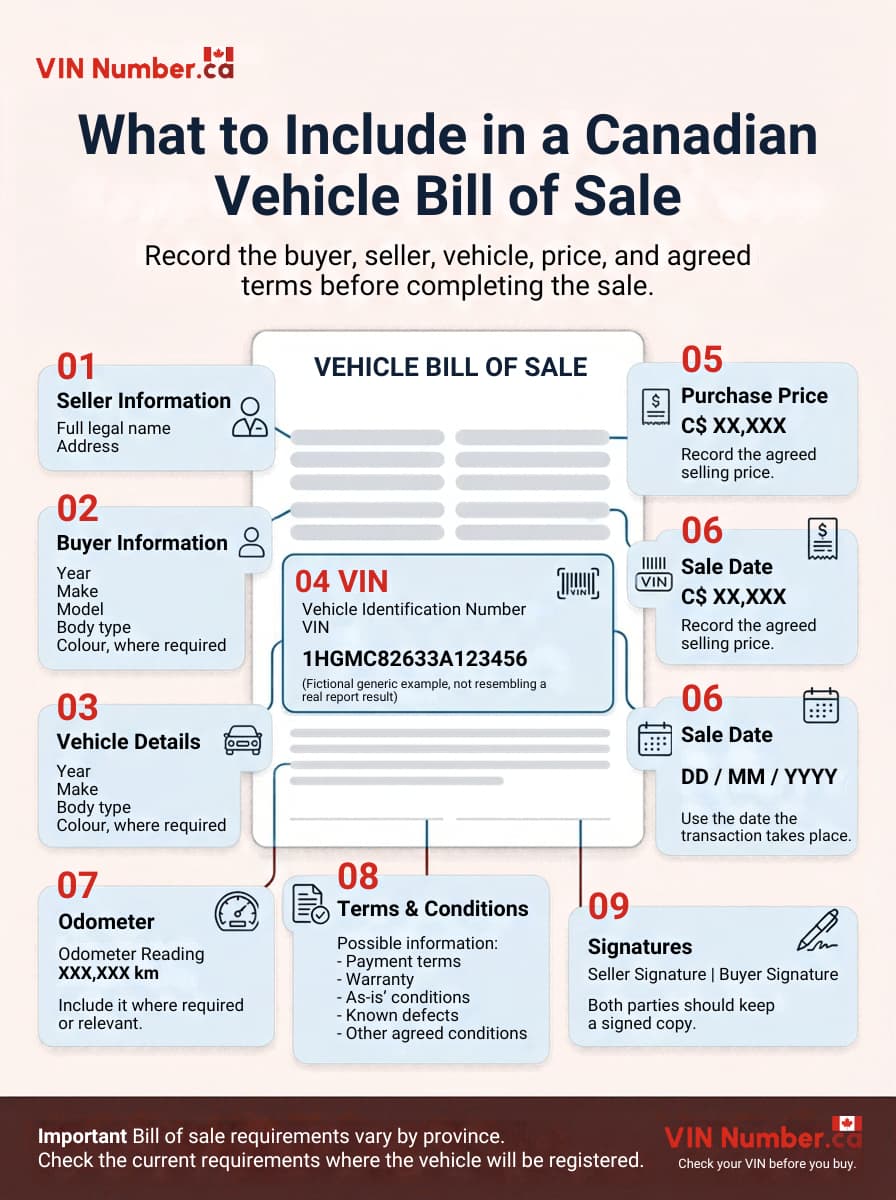
Required Fields Checklist
Depending on the province, the bill of sale can include:
- Full legal name of the seller
- Full legal name of the buyer
- Seller's address
- Buyer's address
- Vehicle identification number (VIN)
- Vehicle year
- Make
- Model
- Body style or type
- Colour, where required
- Odometer reading
- Purchase price
- Date of sale
- Buyer and seller signatures
Some provinces also ask for a statement of whether the vehicle is sold "as is" or with any warranty, and Alberta and Ontario registries will typically ask to see the bill of sale alongside the vehicle's existing registration or ownership document at the time of transfer.
Optional but Useful Information
You can also include:
- Payment method
- Deposit amount
- Remaining balance
- Warranty information
- "As-is" conditions, where appropriate
- Known defects or conditions
- Existing liens or encumbrances
- Special terms agreed upon by both parties
- Witness information, where appropriate
Keep the language clear. Both parties should understand exactly what they are signing.
How Bill of Sale Requirements Differ by Province
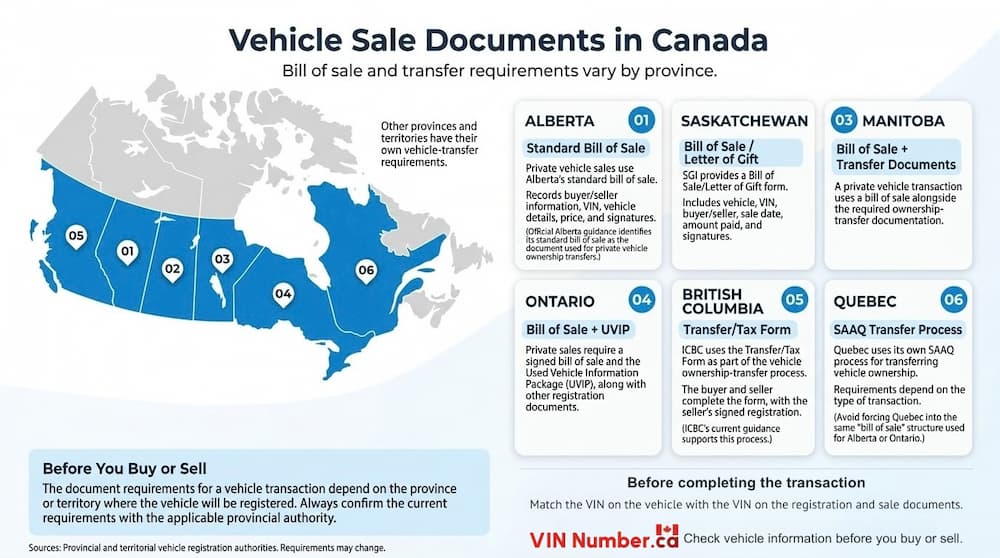
Canada does not have one universal vehicle bill of sale form. Provincial requirements and vehicle-transfer procedures differ.
Alberta
Alberta uses a standard bill of sale for private vehicle sales. The document includes buyer and seller information, VIN, vehicle details, purchase price, and signatures. Alberta also recommends recording the odometer reading, payment details, liens, and special conditions.
Download the official Alberta Standard Bill of Sale
Ontario
Ontario private vehicle sales require additional documentation. The seller must provide the buyer with a Used Vehicle Information Package (UVIP), along with a signed bill of sale containing the required transaction and vehicle information.
Saskatchewan
SGI provides an official Bill of Sale/Letter of Gift form for selling or gifting a vehicle. The form includes the vehicle year, make, model, VIN/serial number, purchaser information, sale date, amount paid, and signatures.
Download the SGI Bill of Sale/Letter of Gift
Manitoba
Manitoba requires a bill of sale for certain private vehicle registration transactions. The document includes information such as the sale date, vehicle details, purchase price, buyer and seller names, and signatures.
Download the Manitoba Bill of Sale
British Columbia
British Columbia uses an ICBC Transfer/Tax Form (APV9T) as part of the vehicle transfer process. The form records information including the VIN, seller, sale date, selling price, and odometer reading.
View the ICBC Transfer/Tax Form
Important
These examples cover some of the major provincial differences. Always check the current requirements of the province or territory where the vehicle will be registered before completing a private sale.
How to Write a Bill of Sale for a Vehicle?
Once you know the applicable provincial requirements, completing the document is straightforward.
Step 1: Confirm the VIN
Start with the vehicle identification number. Compare the VIN on the vehicle with the VIN shown on the registration or ownership documents. A VIN mismatch can create problems during registration and can indicate that the paperwork does not correspond to the vehicle being sold.
[Check vehicle specifications]
Step 2: Enter the Buyer and Seller Details
Enter the full legal names and addresses of everyone involved in the transaction. Use the same names that appear on the relevant ownership and registration documents.
Step 3: Describe the Vehicle
Record the vehicle's:
- Year
- Make
- Model
- VIN
- Body type or style
- Colour, where required
- Odometer reading
Check that these details match the vehicle and its documentation.
Step 4: State the Purchase Price and Sale Date
Clearly record the agreed purchase price and the date the transaction takes place. If the buyer is paying a deposit or the balance will be paid later, document those terms clearly.
Step 5: Add Any Conditions
If the parties have agreed to specific conditions, put them in writing. This can include information about warranties, the vehicle's condition, payment arrangements, or other terms that form part of the agreement.
Step 6: Sign and Date the Bill of Sale
Both the buyer and seller should sign the document. Each party should retain a copy for their records. Province-specific rules can affect which original documents are required for registration, so check the applicable registry before completing the transaction.
What a Bill of Sale Doesn't Tell You
A bill of sale confirms the terms of a transaction, but it does not by itself verify the vehicle's history or condition. It will not necessarily tell you:
- Whether the vehicle has been in an accident
- Whether it has a salvage or rebuilt history
- Whether the odometer reading is consistent with historical records
- Whether the vehicle has been reported stolen
- Whether there are liens or other financial interests
- How the vehicle was previously used
- What factory equipment the vehicle originally had
These details require separate verification. A vehicle history check can help you review available records related to accidents, title status, odometer readings, theft, liens, and other vehicle history with a VIN.
Verify the Vehicle Before You Sign
A bill of sale is more than a simple receipt; it creates a written record of the vehicle transaction and helps both the buyer and seller keep the sale details clear. Since requirements vary across Canada, make sure your bill of sale contains the information required in your province before completing the transaction.
A VIN decoder can help confirm basic specifications such as the year, make, model, and other vehicle details. For a deeper check, a vehicle history report can provide available records relating to the vehicle's history, such as accident, title, odometer reading, lien, theft, and other records.
FAQ’s on How to Write a Bill of Sale for a Car in Canada
What does a bill of sale look like?
A vehicle bill of sale is generally a simple document containing buyer and seller information, vehicle details, VIN, purchase price, sale date, and signatures. Some provinces provide their own forms. Saskatchewan, for example, provides an official Bill of Sale/Letter of Gift form through SGI.
Do I need a bill of sale to register a used car in Canada?
The requirements vary by province. Manitoba requires a bill of sale for privately purchased vehicles, while Ontario requires a signed bill of sale as part of the private-sale documentation. Other provinces use different transfer documents or procedures. Check the requirements of the province where the vehicle will be registered.
Can I write my own bill of sale?
Depends. In some provinces, you can create your own bill of sale as long as it contains the required information. Manitoba, for example, states that sellers can write their own bill of sale or use its template. Other provinces provide specific forms or additional documentation, so check the applicable provincial requirements before using a self-created document.
Does a bill of sale prove a vehicle has a clean history?
No. A bill of sale documents the transaction and the information provided by the parties. It does not independently establish that the vehicle has never been damaged, stolen, rebuilt, liened, or involved in an accident. Check the VIN and available vehicle-history records separately before completing the purchase.