
VIN Search Saskatchewan - Check Vehicle History by VIN
Buying a used vehicle in Saskatchewan? Use the VIN Search in Saskatchewan to get the vehicle history report that can be used to check the vehicle’s records and detailed specifications.
As featured in




Why Do You Need a Sask VIN Search?
For Buyers
Checking the VIN is important before you decide to purchase a used vehicle; it helps you check the vehicle’s condition easily before you decide to buy it.
See if the Vehicle is Damaged
Review the damage that was associated with past incidents or caused by natural incidents like floods. If the vehicle has significant damage on the report, it's best to avoid it.
Verify the Vehicle Legality
Check if the vehicle is branded Total Loss and confirm that the vehicle is not marked Non-Repairable. A vehicle report is crucial to ensure that the vehicle has the right to be driven on the road.
Identify Financial Liens and Debts
Ensure the seller provides a formal lien release from the secured party (bank or lender) before you hand over any payment. Protect yourself from the risk of the vehicle being seized and sold to pay off the previous owner's debt.
Verify the Safety
Used vehicles come in many conditions, including recalled or marked as salvage. As a buyer, it is recommended to use the vehicle history report to ensure that the vehicle is safe and has no unresolved issues.
Why Should You Use the Saskatchewan VIN Number Search?
The SK VIN search tool can be used to decode the VIN and get the vehicle history report. Here are the reasons why it's crucial to use the VIN search service.
Fast and Accurate Results
No need to wait for more than a few seconds; we can generate the vehicle history report in less than a minute! It helps you get the information faster and better.
Detailed Reports
Our reports are designed to be clear and comprehensive. Get the information on liens, claims history, title status, theft records, and usage in the report.
Check the Real Odometer Reading
Our report has included the real odometer reading with the date when it was recorded. It helps you easily track if there’s an odometer rollback case.
Real Auction Photos
You can get up to ten real pictures of the vehicle when it was auctioned. This information is crucial to check before you proceed to buy a vehicle that was sold at an auction.
What Information Can You Get From a Saskatchewan VIN Search?
Once you’ve checked the VIN with our Sask VIN Check, you can get the detailed information of the vehicle, like specifications and records like mileage, title brand check, damage records, stolen vehicle check, and more.
Vehicle Specifications
Verify the vehicle's year, make, model, and trim. Confirm details such as engine specs, transmission type, and country of origin. Ensure the VIN matches the correct model and hasn’t been copied from a higher trim.
Title Brand Checks
Look for title brands like Salvage, Rebuilt, or Flood. These labels can significantly affect the car's value and safety. Understand their implications before purchasing a vehicle with any title brand.
Accident Records
Check the dates and locations of reported accidents. Review the details carefully to avoid cars with significant damage. Even minor accidents may impact the car’s structural integrity and safety.
Damage Records
Check for damage records, such as fire, flood, or structural issues. Examine this section carefully to avoid getting a vehicle that has invisible damage that could be dangerous for both the driver and passengers.
Stolen Vehicle Check
Ensure the car has never been reported as stolen. If applicable, the section will show details like the date and location of theft. Purchasing a stolen vehicle can get the vehicle seized, and you will not get your money back.
Repair Costs and Estimates
Review past repair cost estimates, including parts and labour. This helps assess future repair needs and gauge the quality of past repairs. High repair costs can also help in price negotiations.
Mileage Records
Check reported odometer readings, including the date when the mileage was recorded, and the last recorded mileage of the vehicle. Examine this section carefully to see if the odometer was rolled back.
Vehicle Usage Records
Check if the vehicle was used for commercial purposes, like rentals. A vehicle that was used in business often shows more wear and tear, even with low mileage. This affects the vehicle's condition and lifespan.
Warranty Coverage
Check the remaining warranty coverage, including factory or roadside assistance. This section will tell you if the car is still under warranty. If not, you may need to consider buying an extended warranty.
Recalls Status
Check for any unresolved safety recalls on the vehicle. Safety recalls are addressed at no cost, so it’s important to ensure they are handled. The section helps you to check the causes of recalls, how they were handled, and the status of the recalls (fixed/opened).
How do I check the VIN Number in Saskatchewan?
To use our SK VIN check easily, just follow these steps:
Locate the VIN
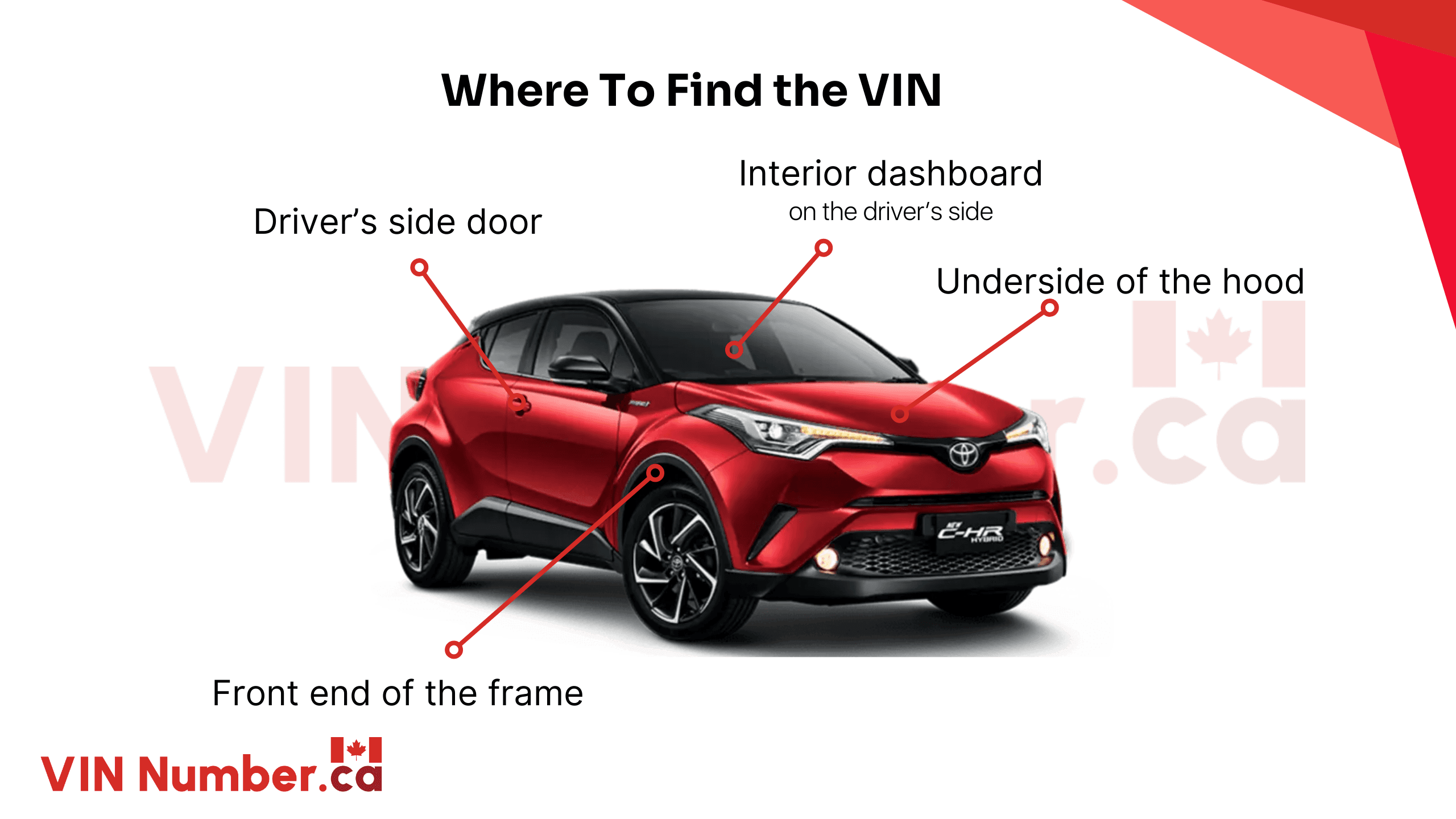
You’ll find the VIN on the dashboard, on the driver’s side door frame, or inside the doorjamb, and in the vehicle’s paperwork.
Enter the VIN on the Form
Fill out the form on this page and click “Check VIN” to begin the search.
Get Your Report
In just a few seconds, you’ll get the full report showing accident history, mileage, title status, and more. You may download the vehicle history report.
Where Can I Find the VIN Number?
It is crucial to physically verify the VIN on the vehicle itself against the number on the registration papers. Any mismatch suggests the vehicle may have been stolen or tampered with.
Driver’s Side Dashboard
The most common location. The VIN is stamped on a metal plate visible through the lower corner of the windshield on the driver's side.
Driver’s Side Door Jamb/Pillar
Look for the sticker or label located on the door frame (where the driver's door latches when closed). The VIN is always printed on this decal.
Vehicle Registration and Insurance Papers
The full 17-digit VIN is always printed on the vehicle’s Registration Certificate and your Insurance Slip.
Other Potential Spots
The VIN is often stamped directly onto the engine block, the firewall in the engine bay, or under the spare tire, though these are less accessible.
Quick VIN Number Breakdown
The Vehicle Identification Number (VIN) is a globally standardised code that acts as the vehicle’s specific identity and manufacturing record. Understanding this 17-digit structure helps you manually verify the report's accuracy.
Manufacturer Identifier (Digits 1–3)
The first three characters form the World Manufacturer Identifier (WMI), indicating where the vehicle was built and by whom.
Digit 1 (Geographic Area)
Identifies the region of the world where the vehicle was assembled (e.g., '1', '4', or '5' for the US; '2' for Canada).
Digit 2 (Manufacturer)
Identifies the specific manufacturer (e.g., 'G' for General Motors, 'F' for Ford).
Digit 3 (Vehicle Type/Division)
Specifies the vehicle type or the manufacturing division.
Vehicle Descriptor Section (Digits 4–9)
The Vehicle Descriptor Section (VDS) detailed the specific characteristics and features of the vehicle model.
Digits 4–8
Specify the vehicle's model line, series, body style, engine type, and restraint system.
Check Digit (Digit 9)
This is the security digit that serves to detect fraudulent or improperly recorded VINs. This digit is random as it is derived from a specific mathematical calculation.
Vehicle Identifier Section (Digits 10–17)
The Vehicle Identifier Section (VIS) details the car's assembly lineage and its serial number.
Digit 10 (Model Year)
Indicates the vehicle's official model year (using a rotating code of letters and numbers).
Digit 11 (Assembly Plant)
Specifies the exact manufacturing plant where the vehicle was assembled.
Digits 12–17 (Serial Number)
The last six digits form the vehicle's production sequence or serial number of the vehicle.
Laws Related to Saskatchewan VIN Checks
Saskatchewan has specific legal requirements, governed primarily by the provincial government, that reinforce why a VIN check is vital for any purchase, sale, or registration. The laws focus on mandatory insurance, proof of ownership, and title status.
Transferring Vehicle Titles in Saskatchewan
The transfer process depends on the VIN and proper documentation, which must be completed at a Motor Licence Issuer. The buyer needs a Transfer of Ownership form (from the previous owner's registration) or a bill of sale, both with the VIN.
Before registration, the VIN must be checked to confirm eligibility and the vehicle's status in Saskatchewan. The buyer is usually responsible for paying the Provincial Sales Tax (PST) before finalising registration.
Insurance and Vehicle Registration in Saskatchewan
In Saskatchewan, vehicle insurance and registration are closely linked, and both rely on the VIN to be valid.
- Mandatory Basic Insurance: Basic plate insurance is legally required and is purchased at the time of vehicle registration. This insurance policy is tied directly to the VIN.
- VIN Status and Eligibility: A vehicle with a severe status, such as Non-Repairable or Hulk, cannot be registered in Saskatchewan. The VIN check confirms the vehicle is insurable and eligible for a licence plate.
- New Residents: New Saskatchewan residents have a maximum of 90 days to register their vehicle in the province, which requires a VIN check and proof of ownership.
Applying for Vehicle Titles in Saskatchewan
The vehicle's legal title status dictates its use and value. The province enforces strict rules based on the VIN to protect buyers from unsafe or irreparable vehicles.
- Salvage and Total Loss: Vehicles declared a Total Loss must undergo a rigorous Structural Inspection before they can be assigned a Rebuilt status and legally registered.
- Out-of-Province Vehicles: Any used vehicle coming from outside Saskatchewan must pass an Out-of-Province Vehicle Inspection before it can be registered.
- Lien Verification: The buyer should always conduct a separate search of the Saskatchewan Personal Property Registry (SPPR) against the VIN to ensure there are no outstanding financial claims, as a lien will prevent a clean title transfer.
Secure the Report Now!
Before you decide to purchase the vehicle, check the records to ensure it has no bad history that could affect its future. Run the VIN and see the records, make sure your dream vehicle is lien-free, has no hidden damage, and is not marked as salvage!
Saskatchewan VIN Lookup FAQs
What is the Saskatchewan VIN Search?
When you want to purchase a used vehicle in Saskatchewan, use the Saskatchewan VIN search to check the VIN and gett the complete vehicle history records. On the report, you can find detailed information like specifications, check the vehicle's title, accident history, auction records, mileage, warranty coverage, and much more.
Checking the VIN is crucial for both the seller and the buyer; it helps both parties have a smooth and safe transaction with no hassle or dispute in the future because everything is cleared up.
How do I check a VIN number for free in Saskatchewan?
You can check the VIN number for free by using an online VIN decoder like VINNumber.ca. Through a free VIN check, you can get useful information like the vehicle’s specifications and the basic market value of the vehicle. To get the complete vehicle information, you can purchase a full vehicle history report.
What are the common red flags found during the Saskatchewan VIN lookup process?
When you run a VIN Check Sask, you may see title brands like salvage, rebuilt, total loss, non-repairable, or unsafe. These tags highlight major events in the car’s past and help you judge whether the vehicle carries risks that could affect safety, insurance, or long-term use.
What is a Vehicle Identification Number in Saskatchewan?
The Vehicle Identification Number (VIN) in Saskatchewan adheres to the global standard: a unique 17-character alphanumeric code that acts as a vehicle's specific "fingerprint." Used for registration, insurance, and theft tracking, the VIN is crucial for checking the vehicle's damage history via Saskatchewan Government Insurance (SGI), with no two VINs being identical.
Is the engine number different from the VIN?
Yes. The VIN is the global, 17-digit serial number for the entire vehicle chassis. The engine number is the unique serial number for the engine block itself. In Saskatchewan, all legal and transactional history checks, registration, and title tracking are done exclusively using the 17-digit VIN.
How is a VIN Number used in Saskatchewan?
The VIN (Vehicle Identification Number) serves multiple crucial functions: SGI uses it for registration, insurance, damage history checks, and detecting illegal activities (curbers); law enforcement uses it to track stolen vehicles; and consumers use it to verify vehicle history and PST status before purchase.
How do I check the status of my vehicle in Saskatchewan?
To check a vehicle's official status (normal, rebuilt, stolen, etc.) and damage history in Saskatchewan, use the VIN Search Saskatchewan. For a better background check that covers vehicles across all of Canada, a paid VIN search is available through the Sask VIN check service.
Can you track a car by VIN number in Saskatchewan?
You can track a vehicle’s history and legal status using the VIN through a report, but you cannot use the VIN to track the vehicle’s real-time location or find the personal information of the current or previous owners due to privacy regulations.
What if I don’t find the information that I am looking for?
If your report is missing an accident or detail you suspect, it means the incident was not reported to the police or the provincial insurer, or it was settled privately without an official claim. History reports rely only on reported data. If you have any doubts, you can contact our customer service team.
Do you cover all vehicle makes and models?
Yes, because the 17-digit VIN is a globally standardised code for all passenger vehicles and light trucks manufactured after 1981, our system is also able to decode VINs from before 1981 that only have 5 to 14 digits of numbers.
Where does your data come from?
Our comprehensive reports pull data from several key trusted sources across North America:
- Provincial Vehicle Registry: For status, registration, and claims history.
- Saskatchewan Personal Property Registry (SPPR): For lien checks.
- Insurance Bureau of Canada (IBC): For insurance claims data.
- Canadian Police Information Centre (CPIC): For stolen status checks.
- National Motor Vehicle Title Information System (NMVTIS): For U.S. history and brands.