
VIN Search Ontario
When you want to buy a used vehicle in Ontario, whether it's a car, truck, motorcycle, or ATV, be sure to use the Ontario VIN search and obtain the vehicle report. Check the specifications and past records, like accidents, auctions, mileage records, and more!
As featured in




Why Do You Need an Ontario VIN Check?
For Buyers
For you, the buyer, the VIN search is the necessary tool for due diligence. It stops a quick shine job from hiding a catastrophic history and ensures the person selling you the car is legally entitled to do so.
Verify the Vehicle History
Check if the car was in an accident or had its odometer tampered with, so you do not accidentally buy a vehicle that was in an accident or had its odometer rolled back.
Ensure the Title is Clear of Liens
Outstanding debt is the number one financial trap. That is why the vehicle report is important to check if any lien/loan records weren’t paid off by the previous owners, so the lien is not your responsibility to pay off.
Verify the Maintenance History
A vehicle history report can help you find out if the vehicle was regularly serviced by the previous owner. If the vehicle is not regularly serviced, do not proceed to purchase.
Detect Mileage Fraud and Tampering
Check the actual mileage number to see if it matches the seller’s description. If the odometer reading is different from the claim, be aware that it might have been tampered with.
Real Story: Salvage Record Prevents Buyer From Paying $13,500
Mark Chen was ready to pay $13,500 for a 2020 Honda Civic listed on AutoTrader in Toronto, Ontario. The seller called it a rare find in great shape, worth every penny. Before signing anything, Mark ran an Ontario VIN search and found something the seller never mentioned.
What the Report Found
- A salvage brand record⚠️
- 2 damage records ❌
- 1 recall record ⚠️
- Last odometer reading: 90,803 miles
Possible Past Incidents and Vehicle Condition
The salvage brand and two damage records show this Civic went through serious repairs. The open recall means a part may still need fixing before safe use.
How the Report Helped
Mark backed out of the deal, saving $13,500 and avoiding a car with a hidden salvage past
Why Should You Use Our Ontario VIN Check?
At VINNumber.ca, you can get a fast and reliable vehicle history report. Our VIN check service helps you see if the vehicle has any hidden defects or even still tied to a lien, to ensure you have a pleasant buying experience.
Fast and Accurate Report
Get your report in minutes. We pull data from trusted Canadian sources to ensure the information is accurate and up-to-date.
Lifetime Access
Unlike other VIN report services, you can access the VIN report every time you want without limitations.
Affordable Price
We provide flexible pricing to suit your needs, whether you’re running a single search or ordering reports in bulk for a dealership
Comprehensive Report
Get the detailed information of all vehicles, including vehicle specs, accident history, mileage records, repair costs, and more in the report.
What Information Will You Get Through an Ontario VIN Check?
A VIN check in Ontario tool can help you get detailed information about your vehicle. Here’s what you will be getting from the vehicle history report.
Vehicle Specifications
Verify the year, make, model, and trim of the vehicle. Check essential details such as engine specifications, transmission type, and country of origin. Also, confirm the MSRP to help you negotiate or set the price accordingly.
Title Brand Checks
Look for title brands like salvage, rebuilt, non-repairable, flood, fire, hail, or lemon. Understanding these brands is crucial, as they can significantly affect the car's value and safety. Ensure you fully understand any implications before purchasing a vehicle with a branded title.
Accident Records
Check the date and location of any accidents reported for the vehicle. Thoroughly review the details to avoid purchasing a car with potentially dangerous damage. Even minor accidents can impact the vehicle’s structural integrity and safety.
Damage Records
Review records for major damage, such as fire, flood, structural issues, or significant mechanical repairs. Some vehicles may have been repaired without being declared a total loss, so it's essential to assess whether the damage affects the car’s long-term reliability.
Stolen Vehicle Check
Ensure the vehicle has never been reported as stolen. This section will provide details on the date and location of the theft, if applicable. Buying a stolen vehicle can lead to the car being seized by authorities, and you will not get your money back.
Repair Costs and Estimates
Examine the repair cost estimates for past issues, including parts and labor. This information is valuable for understanding future repair needs and assessing the quality of past repairs. High repair costs can also be used as leverage during price negotiations.
Mileage Records
Review a timeline of reported odometer readings along with the recorded date and last recorded mileage. This section helps you ensure that the vehicle has not had its odometer rolled back and check its last recorded mileage to match the seller’s claim.
Vehicle Usage Records
Check if the vehicle has been used for commercial purposes, such as a rental or fleet vehicle. Cars that have been heavily used for business purposes typically experience more wear and tear, even if their mileage seems low. This can affect the car’s overall condition and lifespan.
Warranty Coverage
Review the remaining warranty status, including factory coverage or roadside assistance. This section will tell you whether the vehicle is still under warranty or if you’ll need to buy an extended warranty for additional coverage after purchase.
Recalls Status
Check for any unresolved manufacturer recalls on the vehicle. Safety recalls should be addressed immediately, and most repairs are done free of charge. The recall section will provide information on the cause, date of the recall, and whether it has been resolved or is still open.
How to Run a VIN Search in Ontario?
Getting a vehicle history report through the VIN search Ontario service is easy. You just need a VIN and a stable internet connection to do it. Follow these simple steps to get it done:
Find the VIN
Locate the VIN on the vehicle. It can usually be found on the dashboard (visible through the windshield) or the doorjamb.
Fill in the Form
Enter the VIN into the search form on this page and click "Check VIN.".
Download the Report
Check the preview page, then proceed to payment to get the full vehicle history report. After that, you can download the vehicle history report in PDF format.
Where Can I Find the Vehicle VIN Number?
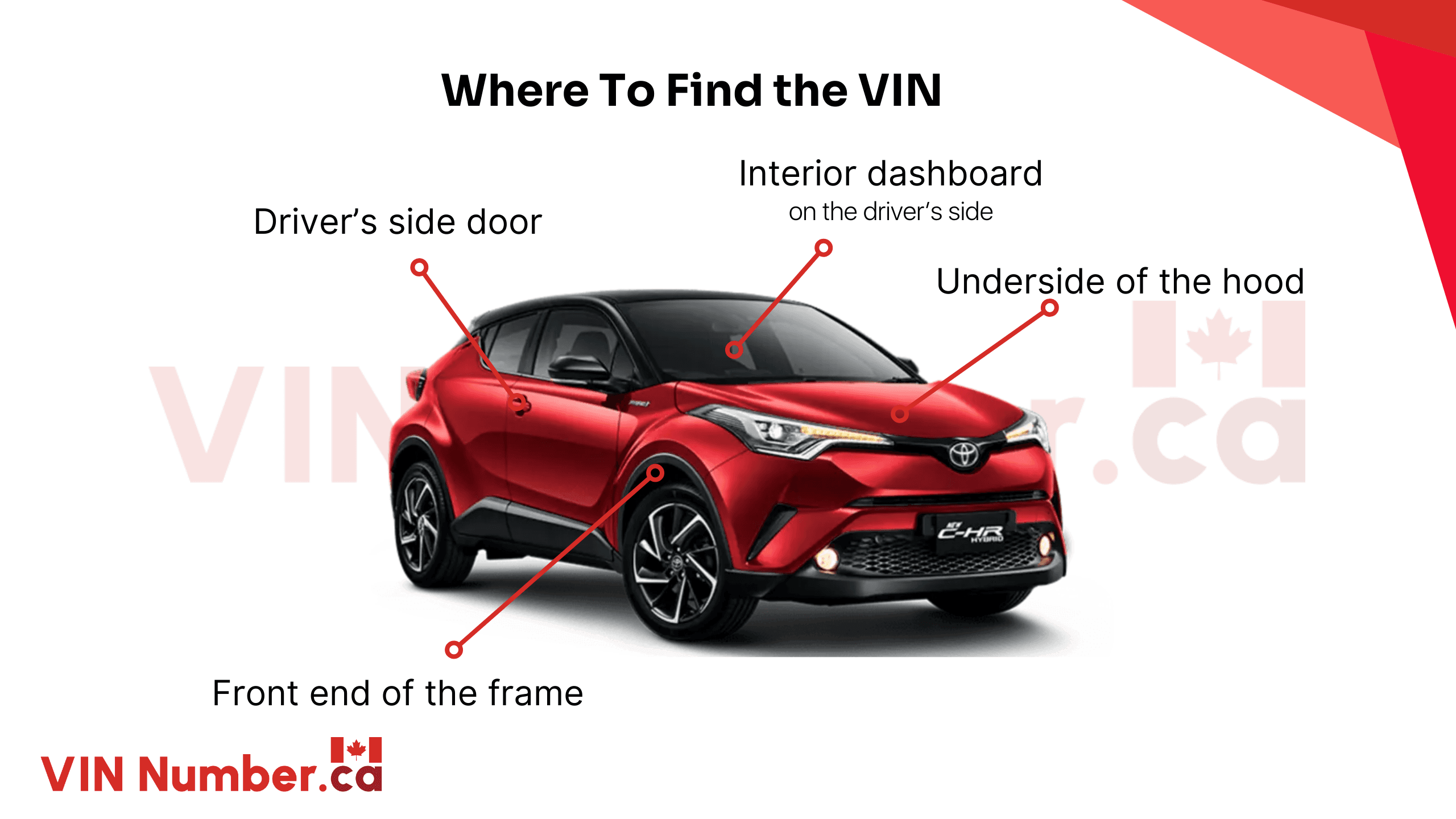
Finding the Vehicle Identification Number is simple because manufacturers place it in spots that are easy to reach. Always check that the VIN on the car matches the one on its documents to make sure the number has not been changed or swapped.
Driver’s Side Dashboard
The most common location. The VIN is typically stamped on a metal plate visible through the lower corner of the windshield on the driver's side.
Driver’s Side Door Jamb/Frame
Look at the sticker or label located where the driver's door latches when closed. This label often contains manufacturing details and the VIN.
Vehicle Registration and Insurance Papers
The full 17-digit VIN is always printed on the vehicle’s Registration Certificate (owner's permit) and your Insurance Slip. Always use these documents to verify the VIN stamped on the car.
Engine Block or Firewall
Sometimes the VIN is stamped directly onto the engine block or the engine bay's firewall, though this is harder to see.
Other Spots
Less common locations can include under the spare tire, on the underside of the hood, or beneath the driver's seat carpet.
How to Break Down the VIN Number?
A VIN is made up of 17 characters, and each section tells a different part of the vehicle’s story. It’s divided into the WMI, VDS, and VIS, which work together to show who built the vehicle, what it is, and its unique identity.
World Manufacturer Identifier (Digits 1–3)
The first three characters make up the World Manufacturer Identifier (WMI). This section tells you exactly who built the car and roughly where it was built.
Digit 1 (Geographic Area)
Identifies the region of the world where the vehicle was assembled, such as '1', '4', or '5' for the United States, or '2' for Canada.
Digit 2 (Manufacturer)
Identifies the specific manufacturer, often corresponding to the name of the company, like 'G' for General Motors or 'B' for BMW.
Digit 3 (Vehicle Type/Division)
When combined with the first two digits, this final WMI character often specifies the vehicle type (like a truck or passenger car) or the manufacturing division within a corporation.
Vehicle Descriptor Section (Digits 4–9)
The middle section is known as the Vehicle Descriptor Section (VDS). These characters detail the specific characteristics of the vehicle model. This is where you confirm things like the body style and engine.
Digits 4–8 (Vehicle’s Features)
These positions vary significantly by manufacturer but generally specify the vehicle's features, including the model line, series, body style, engine type, and restraint system (airbags).
Check Digit (Digit 9)
The check digit is determined by a mathematical formula applied to the other sixteen characters in the VIN. The check digit must match the result of that formula; if it doesn't, the VIN is invalid or has been tampered with.
Vehicle Identifier Section (Digits 10–17)
The final eight characters form the Vehicle Identifier Section (VIS), which is unique to that specific vehicle. It details the car's assembly lineage and its serial number.
Digit 10 (Model Year)
The 10th character indicates the vehicle's official model year. It uses a rotating code of letters and numbers (excluding I, O, Q, U, and Z).
Digit 11 (Assembly Plant)
This single character specifies the exact manufacturing plant where the vehicle was assembled.
Digits 12–17 (Serial Number)
The last six digits form the vehicle's production sequence or serial number. This number makes the VIN truly unique, differentiating your specific car from every other one of the same make, model, and year.
Laws Related to Ontario VIN Check
Transferring Vehicle Titles in Ontario
When buying a used car in Ontario from a private seller, the law dictates a clear process centred on the VIN to ensure a clean transfer of ownership.
Mandatory UVIP
The seller is legally required to provide the buyer with the Used Vehicle Information Package (UVIP) for most private vehicle sales. The UVIP uses the VIN to provide the registration history, lien status, and fair market value to the buyer.
Bill of Sale
Both the buyer and seller must complete and sign the Bill of Sale, which must accurately record the vehicle's VIN.
Safety Standards Certificate (SSC)
To register a used vehicle, it must pass a safety inspection and receive an SSC, which is tied to the VIN, confirming the vehicle meets minimum road safety standards.
Don’t Forget to Use the VIN Search in Ontario!
Access vehicle information sourced from a wide range of trusted Canadian and North American databases. Our reports are compiled using records from provincial registration agencies, insurance-related databases, vehicle auctions, theft and recovery records, and proprietary vehicle sales data, helping you make more informed decisions with confidence.
A used vehicle’s sleek appearance can easily hide structural damage, undisclosed accidents, or hidden debt. In the Canadian used car market, a VIN check is a preventive way to help you check the vehicle’s actual condition before you purchase the vehicle. Check the VIN and get the report to see the vehicle’s actual condition!
FAQs About VIN Search in Ontario
What is an Ontario VIN Search?
When you purchase a used vehicle in Ontario, be it a car or motorcycle, remember to always run the Ontario VIN check before you decide to purchase the vehicle. This check helps you find the vehicle’s specifications and records like accident, auction, stolen check, maintenance history, recalls, title brands, odometer reading, and damage record.
To run an Ontario VIN lookup, you can click on the form above and fill in the VIN. An Ontario VIN check is crucial for first-time buyers. It is useful to make sure the vehicle is not stolen, has no unpaid loan, and helps you see the price according to the MSRP and the actual condition of the vehicle.
How do I check a VIN number for free in Ontario?
To check a VIN number for free in Ontario, you can use our Ontario VIN search tool and get the basic information about the vehicle, like the market value and specifications.
How is a VIN number used in Ontario?
In Ontario, the VIN is essential for identifying a vehicle during registration, insurance, and ownership transfers. It’s used to confirm history, such as accidents, liens, and recalls, check for theft or tampering, and help ServiceOntario match the car to official records for smooth processing.
What are the common red flags found during the Ontario VIN lookup process?
Common red flags in an Ontario VIN lookup include salvage or rebuilt titles, active liens, major accident history, odometer issues, and gaps in service or registration records. Missing import or export details can also signal trouble, and if a seller refuses to share the VIN, that’s a clear warning to walk away.
Does a VIN report cover American cars?
Yes, you can use VINNumber.ca to decode American cars, even though you are living in Canada. As long as you have an American car and an American VIN, you may use our VIN check tool to check the VIN.
Is the engine number different from VIN?
The Vehicle Identification Number (VIN) is the permanent identifier for the vehicle as a whole, stamped on its chassis. The engine number is a separate serial code assigned specifically to the engine for tracking parts, warranty, and recalls.
How to conduct a VIN lookup by license plate in Ontario?
You can order the mandatory Used Vehicle Information Package (UVIP) using either the VIN or the licence plate number if you are the seller or a party involved in the transaction. However, the resulting report will always be tied to the VIN, which is the official permanent vehicle identifier.
How do I check the status of my vehicle in Ontario?
To check a vehicle’s status in Ontario, use the VIN Check Ontario to confirm plate and permit details, review the ownership papers for any brands such as salvage or rebuilt, and run a VIN-based history search to see records like accidents, liens, or registration updates.
Can you track a car by VIN Number in Ontario?
No, a VIN alone can’t pinpoint a vehicle’s live location in Ontario. It can, however, be used for important checks like confirming whether the vehicle is listed as stolen through the vehicle history report. For stolen vehicles, the VIN plays a major role in police recovery efforts, but the case must be officially reported before any search can begin.
What if I don’t find the information that I am looking for?
If the l report is missing an accident that you know occurred, it likely means the damage was not reported to the police or was settled privately without an insurance claim. Vehicle history reports rely on reported data. If you have concerns, the information is incomplete, or the mileage seems off, your next step should always be to hire an independent, licensed mechanic for a comprehensive pre-purchase inspection.
Do you cover all vehicle makes and models?
Yes. The 17-digit VIN is a global standard for virtually all passenger cars, light trucks, and SUVs manufactured after 1981. Any official VIN search system or comprehensive report will cover all makes and models, relying only on the availability of records from provincial, police, and insurance databases.
Where does your data come from?
Our data comes from trusted institutions across Canada. We collect information from provincial and territorial motor vehicle registries to confirm legal ownership, title brands, and lien status. We also cross-check records with law enforcement databases like CPIC for theft reports, as well as auction houses and private service centers for additional history details.