
Carfax VIN Decoder
Wrong vehicle representation can lead to buyer’s regret and hurt the seller’s reputation. Use our Carfax VIN decoder to get clear, detailed specs and report of any vehicle’s past with just one click. Enter the VIN and trust us with the rest.
As featured in




What is a VIN and Why is It Important?
A VIN (Vehicle Identification Number) is a car’s unique fingerprint. This 17-character code is packed with details, everything from where your vehicle was built to the type of engine under the hood, the trim level, transmission, and more.
Decoding a used car’s VIN is essential in:
- Verifying the specs and features
- Tracking its history and condition
- Checking for recalls
How Our Carfax Free VIN Decoder Helps
Our free tool provides premium service to cater to different users, like:
Used Car Buyers
Confirm the real specs, features, and origin of a used car to avoid being tricked by false listings or hidden changes.
Dealers & Auto Resellers
List cars accurately, reduce complaints, and build trust with customers by showing verified vehicle details directly from the manufacturer and registry data.
Auto Insurance Providers
Know the exact trim, engine type, and safety features, which can help calculate fair and accurate premiums for every policyholder.
Car Importers/Exporters
Check where the car was made, its emission standards, and key details needed for customs clearance and legal compliance.
Mechanics & Inspectors
Use the information to know the exact engine, drivetrain, and specs, to help make proper repairs, order correct parts, and avoid service mistakes.
Car Enthusiasts
Find out if a car has rare trims, performance packages, or special factory options that match collection or restoration goals.
Vehicle Appraisers
Appraisers verify model, trim, and features to assign the right market value and avoid underpricing or overpricing vehicles during evaluation.
Fleet Managers
Track each vehicle’s specs, fuel type, and configuration, helping with service planning, fuel tracking, and budget control for entire fleets.
What to Learn with Our CARFAX VIN Decoder?
Our Canada Carfax VIN Decoder alternative reads and interprets the 17-digit VIN to reveal the following specs:
If you want full details about any vehicle’s specs, features, options, original MSRP, and more, our window sticker lookup service gives you all that in one click. It’s clear, accurate, and easy to understand.
- Year
- Make
- Valve train design
- Country
- Exterior dimensions
- Interior dimensions
- Delivery charges
- Number of doors
- Suspension
- Steering
- Ground clearance
- Traction battery
- Weight
- Standard seating
- Engine Size and specs
- Model
- MSRP
- Transmission style
- Drive Type
- Body type
- Fuel type
- Tank capacity
- Seating
- Braking
- Trailering
- EPA Class
- Range extender
- Displacement
- Engine model
- Engine Description
- Trim
- Mileage
- Engine configuration
- Front airbag information
- Tire pressure and size
- Seat belt type
- Emissions
- Wheels
- Off-road attributes
- Cargo dimensions
- Electrical specifications
How to Use Our VIN Decoder?
Locate your VIN:
Usually found on the dashboard near the windshield or inside the driver’s door. You can also check the vehicle registration.
Enter the VIN:
Input the 17-character code, including your email address and phone number into the VIN search tool above.
Click ‘Decode VIN’:
Submit the form and leave the rest to our tool to analyze the VIN and pull up key information.
Get Result:
Immediately view basic information like the specs, engine and transmission.
Where is the VIN Located on My Car?
Different car brands place the VIN in specific spots, and older models may have it in less common places. While most modern vehicles follow a standard layout, it's good to know that VIN locations can vary slightly.
Here’s where you can usually find your VIN:
Dashboard (driver’s side, outside)
Direction
Look through the windshield on the driver’s side, near the bottom corner.
Driver’s door frame (inside)
Direction
Open the door and check the label on the pillar or edge of the door.
Under the hood (engine bay, inside)
Direction
Check the firewall or near the engine block.
Front of the car frame (underneath, outside)
Direction
Some cars have it stamped near the radiator support or frame rail.
Rear wheel well (inside)
Direction
Look above the tire in the wheel arch.
Driver’s side floor (inside)
Direction
Lift the carpet near the seat for a stamped VIN on the chassis.
Trunk or spare tire area (inside)
Direction
Look under the mat or near the tire compartment.
VIN Number Structure and Breakdown
A Vehicle Identification Number (VIN) is a 17-character code that uniquely identifies a vehicle. It’s divided into three sections: WMI, VDS, and VIS.
- WMI (World Manufacturer Identifier) – Characters 1–3: Identifies the vehicle’s manufacturer and country of origin.
- VDS (Vehicle Descriptor Section) – Characters 4–9: Describes the vehicle’s model, body type, engine, and safety features.
- VIS (Vehicle Identifier Section) – Characters 10–17: Provides model year, manufacturing plant, and production sequence number.
What Each VIN Digit Means?
Let’s break down this sample Canadian VIN: 2HGFC2F59JH000123
Character | Meaning | Interpretation |
|---|---|---|
2 | Country of manufacture | Canada |
H | Manufacturer | Honda |
G | Vehicle type | Passenger car |
F | Series | Civic |
C | Body style | 4-door sedan |
2 | Engine | 2.0L I4 |
F | Restraint System | Manual seatbelts, front airbags |
5 | Trim level | LX |
9 | Check digit | VIN validator |
J | Model year | 2018 |
H | Assembly plant | Alliston, Ontario, Canada |
000123 | Sequential production number | Vehicle number 123 |
Get More with a Paid Carfax VIN Decoder
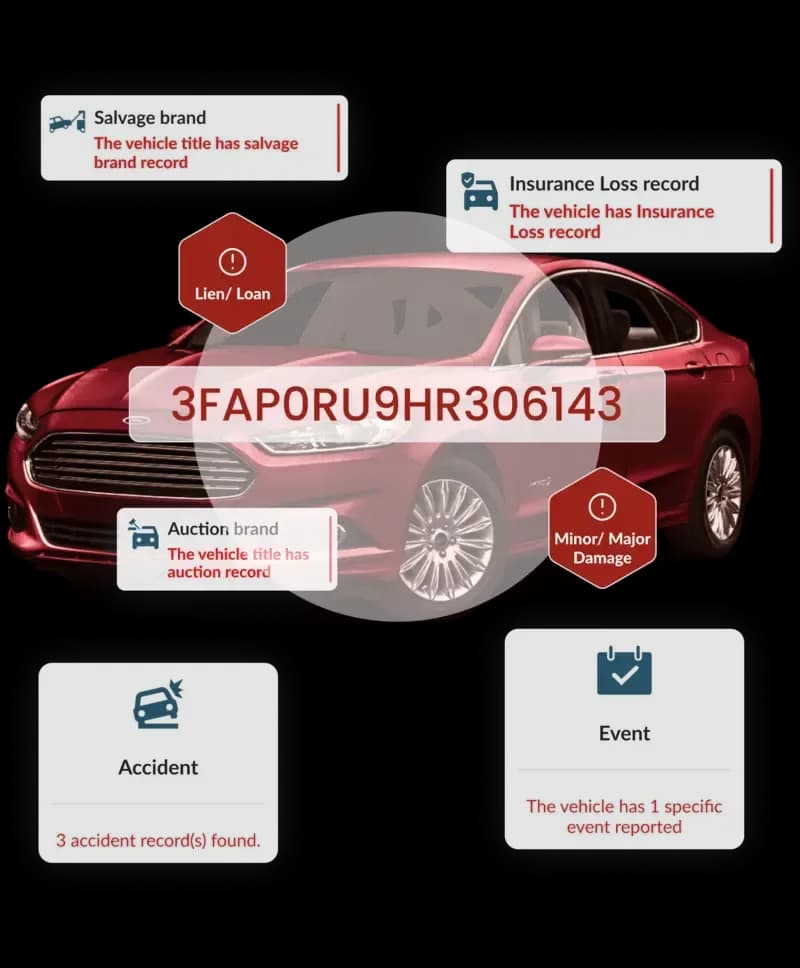
If you’re buying a used car or you run a used car dealership, getting the vehicle history report can make a huge difference between a good and a bad deal. Here’s what you’ll get by using our paid Canada VIN check:
- Ownership history
- Title history
- Accident and damage records
- Lien and loan status
- Odometer readings
- Theft records
- Sales history
- Service and maintenance records
- Auction records and images
- Recall information & more
How Accurate is Our Carfax VIN Decoder?
We know accuracy matters, especially when it comes to vehicle information. Our Carfax VIN decoder Canada pulls data from certified sources, including provincial registries, insurers, and repair databases.
You get instant, accurate, and up-to-date information that’s just as precise as what you’d expect from top providers like Carfax, sometimes even more comprehensive.
Start Your VIN Decoding Journey Now!
See what a vehicle is hiding
Enter your VIN below and get instant results.
Brands Supported by Our Canada VIN Decoder
Frequently Asked Questions
Where is the VIN number on a car?
You’ll usually find the VIN number in the following places:
- On the driver’s side dashboard (visible through the windshield).
- Inside the driver’s door frame.
- On the engine firewall.
If you can’t access the car, you can check the vehicle registration, insurance documents, or owner’s manual.
How do I check a CARFAX VIN number for free?
To lookup a VIN number for free, simply use our Carfax free VIN decoder. This allows you to retrieve and confirm details such as the year, make, model, trim, engine, transmission, and more. It’s a good starting place when researching original details about a vehicle. If you’re buying a used car, you can upgrade to a paid service to access the vehicle history report.
Can my VIN number tell me what features my car has?
Yes! The VIN reveals engine specs, transmission type, trim level, and factory-installed options. Knowing the original features a car came with helps in verifying its authenticity and value.
Can I perform a VIN lookup on an older car?
Yes. Our specialized tool also supports classic car VIN decoding. If you’re researching an old car manufactured before 1981, and with a shorter VIN ranging from 5 - 14 digits, simply run a classic car VIN number using our tool to get details including the specs, engine, transmission, and even the classic car history.