
Get Your Canadian VIN Search Report Instantly
Have a plan to buy a vehicle in Canada? Run a VIN search in Canada and get the vehicle history report to help you check if the car was ever in an accident, auctioned, or has high mileage.
As featured in




Why Should You Choose VIN Search by VINNumber.ca?
After years of watching buyers get burned by stale or incomplete data, we structured our service to be the most reliable source for Canadian vehicle history. Here are the reasons why you should run a VIN search with us:
Unmatched Report Depth and Detail
Our reports go deeper than the rest, including crucial details like US import records, auction flags, and a detailed usage history, the data that usually exposes the hidden fraud.
Permanent Access to Every Report
Most services delete your report within a month, not us. You get lifetime access to your vehicle's report, allowing you to reference it anytime.
Designed for Affordability
Due diligence shouldn’t be prohibitively expensive. Our pricing is highly competitive, offering exceptional value whether you're a first-time buyer or managing a commercial fleet.
Support from Industry Experts
Our support team is built from people with real automotive experience who can help you fix the issues accordingly.
Real Story: How a VIN Search Cuts Corolla Price From $8000 to $3000
Priya Nair found a 2015 Toyota Corolla listed for $8000 on Kijiji in Mississauga, Ontario. The seller said it ran great and looked clean. Before any payment or negotiation, Priya ran a VIN search to confirm the truth. With what she got, she confidently talked the seller down to just $8000 $3000 ✅.
What the Report Revealed
- A salvage brand record ⚠️
- 3 accident records ❌️
- 1 auction/sales record
- 2 open recall records ⚠️
Possible Past Incidents and Vehicle Condition
Three accidents and a salvage brand point to serious past damage. The open recalls also mean some parts may still need fixing for safe driving.
How the Report Helped
Priya used the report to knock $5000 off the asking price, getting a fair deal instead of paying huge for hidden damage.
What is included on Our VIN Search Report?
Here is a detailed breakdown of the eight essential components you should expect in a comprehensive report.
Vehicle Specifications
Every vehicle history report has a section that details the vehicle’s specifications. This section helps you to ensure that the vehicle’s specifications match the seller’s claim.
What’s on the Vehicle Specifications?
In this section, you will be getting the detailed information like the year, make, model, fuel type, country of origin, engine type and capacity, vehicle type, body type, doors, transmission types, and the MSRP.
Title Brand Check
The report protects you from title washing scams, where a brand is hidden by transferring the vehicle to a different province. Our VIN search tool lets you look up salvage, rebuilt, junk, flood-damaged, fire-branded, lemon vehicles, and any other branded titles.
Lien Title
A lien means a lender or company still has a financial claim on the vehicle, and ownership can’t be legally transferred until the outstanding debt is fully paid.
Title Jumping
This happens when a vehicle is passed through multiple buyers, and each seller signs the title to the next person without completing official registration, making the sale illegal.
Branded Title
Some vehicles carry a permanent status like “salvage,” showing that the car has been in a major accident or suffered from extensive damage.
Error or Disparency
Incorrect information on the title, such as wrong names or addresses, dates, or even VINs, can cause delays in ownership transfer.
Stolen Vehicle Status
Simple, yet absolutely vital: is the vehicle currently, or has it ever been, flagged as stolen? Immediately flags if the vehicle is currently reported as stolen by any law enforcement agency in Canada. Be aware that if you accidentally buy a stolen vehicle, it can be seized by the authorities, and you will not get it back.
Stolen Vehicle Information
Check the date, location, and the data source of the stolen vehicle with the VIN search.
Accident History
Accident records detail the financial claims associated with the vehicle, providing a verifiable log of collisions and damage sustained. This section details the location and the date when the accident happened.
Vehicle’s Accident Information
On the report, you can get the detailed information on the accident history, like the date, location, and how many times it was involved in an accident.
Damage Verification
Records whether the damage was from a collision, fire, theft, or an environmental event like flood or hail damage. Many reports will detail where the damage occurred (e.g., rear quarter panel, front subframe), helping your pre-purchase inspection focus on the most vulnerable areas.
Vehicle’s Damage Information
On the vehicle history report, we detail the complete information of the vehicle, like major/minor damage from accidents, hail damage, flood damage, fire damage, and much more.
Odometer Recoreds
The report highlights any logical inconsistency, such as a low reading following a higher one, the clearest indicator of tampering. Here’s what
Recorded Mileage
Check on the recorded mileage of the vehicle. In this section, you’ll get to see the date and the recorded mileage. It is easier for you to spot if there are inconsistencies between the recorded data.
Last Recorded Mileage
Not only recorded mileage, but our vehicle report also reported the last recorded mileage before the vehicle was put on sale.
Ownership Records
Check how many past owners have owned the vehicle. The frequency of ownership changes and the type of use can be huge red flags.
Check the Detailed Ownership Information
This section details how many owners the vehicle had, including the location, date of purchase, and period of ownership. Please note that we do not show the past owners’ private information, like names, addresses, and contact information.
Past Usage Records
Different usage has different wear and tear. That is why it's crucial to know how the vehicle was used in the past. This section also helps you identify if the vehicle was a Personal ride, a Rental car (often driven hard by many people), a Taxi, or part of a commercial Fleet.
Recall Report
Safety first, always. This part of the report shows if the vehicle was ever recalled by the manufacturer.
What is included in the recall section?
You’ll see the date of recalls, causes, and steps taken by the manufacturer to fix the recall issues. The recall report section helps you flag any pending recalls related to critical systems like brakes, steering, or airbags.
Auction Records
If a vehicle was sold through a public auto auction, it often signals a total loss, end-of-lease, or wholesale transaction.
What’s in the Auction Records Section?
In the report, you will get the detailed information of the vehicle when auctioned, like the date, location, and final price. Also, you will be getting up to ten pictures that show the vehicle's condition when it was auctioned.
Why You Need a Vehicle History Search in Canada?
Why bother with a report when the seller seems honest? Because the seller, even the most honest ones, might not know the actual information about the vehicle. That is why it’s crucial to search the VIN in Canada to ensure each party knows all the details of the vehicle.
Here are the reasons why a VIN search is crucial for every buyer and seller.
For Buyers
See Undisclosed Damage History
The report shows accident claims filed with insurance companies, often with damage estimates and locations. With a vehicle history report, you can check for accident reports and the severity of the damage claim. Also, you may look for weather-related damage, like flood or hail, which can lead to expensive electrical issues.
Check the Actual Title
The vehicle report also highlights the vehicle’s title to help you make sure that it's clean and is good to buy. Finding out after you've paid that there's money owed on the vehicle (a lien) means the previous owner's debt becomes your problem. The title status also confirms if the car can legally be registered and driven in your province, which is obviously important.
Detect Odometer Rollback Fraud
One of the oldest tricks in the book is mileage tampering. A history report provides a timeline of recorded mileage at various points by highlighting the date, year, and mileage records. If you spot any inconsistencies, be aware that it might have been tampered with.
Assess Maintenance and Service Regularity
The report includes records of oil changes, major service intervals, and manufacturer recalls. A well-maintained vehicle suggests an owner who cares about their vehicle and ensures you’ll be getting a vehicle that is in good condition.
How to Get a VIN Search Report?
To get the vehicle history report, all you have to do is perform a basic VIN search. Follow these simple instructions to get yours:
Enter the VIN
Find the VIN of the vehicle you want to check. After that, fill out the form above with the VIN.
Search the VIN
After you have typed the information into the form, click on the “Search VIN” button to begin the process. Our system will generate the report automatically.
Get the Report
Get the vehicle history report in under a minute and examine what has happened to the vehicle’s past; See if it has an accident report, damage report, and more.
Where to Find the VIN?
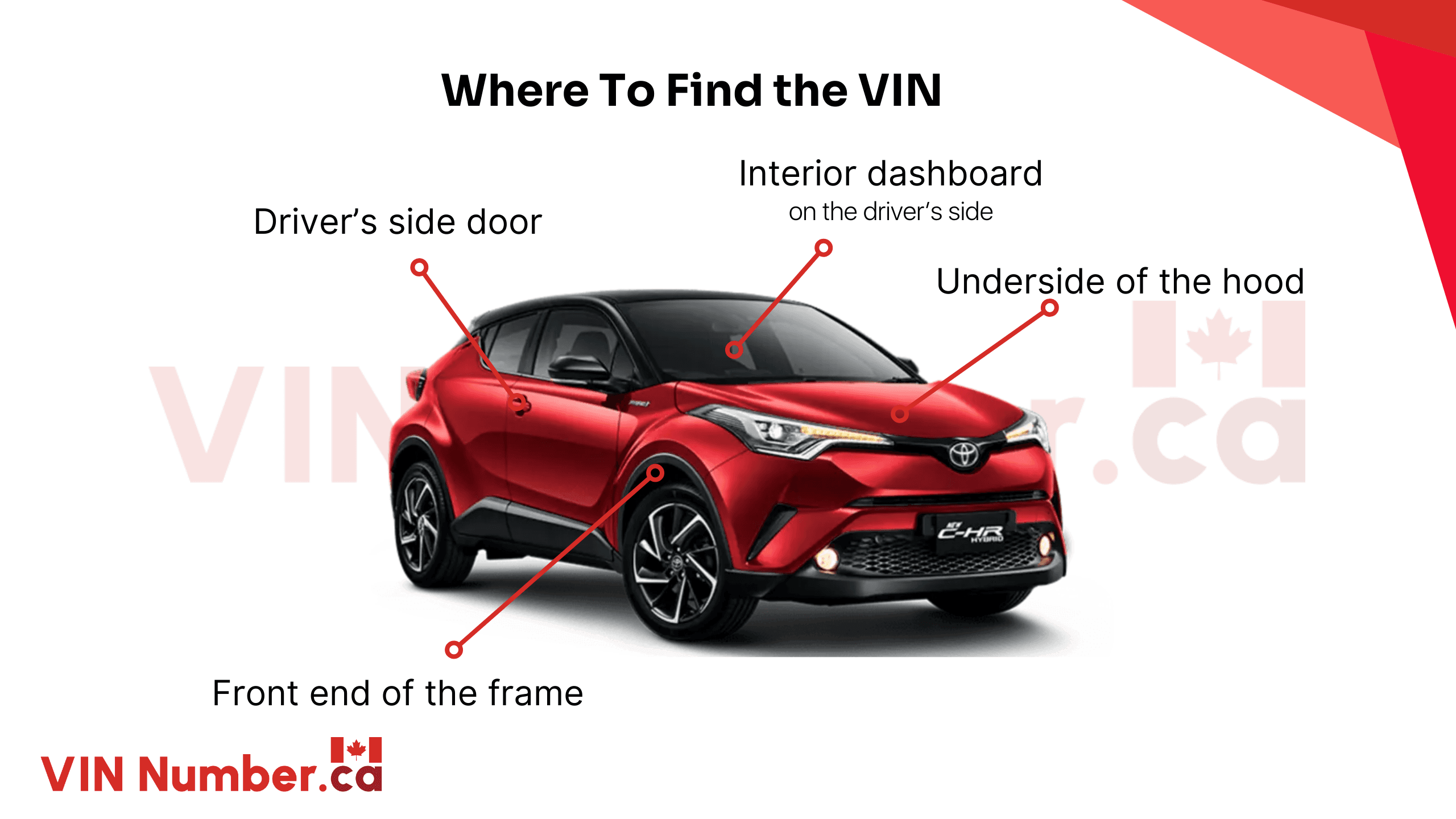
To find the VIN on a vehicle, you can examine the paperwork, like the owner's manual or registration papers. However, if you want to find the VIN on the vehicle’s body, you can examine these locations:
Driver’s Side Dashboards
Look through the windshield at the corner where you can see the driver’s side dashboard.
Driver’s Side Doorjamb
Check on the driver’s door and find a sticker on the doorpost near the frame. The VIN is usually stamped on the sticker.
Other Location
Check on the engine bay, the frame under the hood, or near the spare tire in the trunk. In addition to that, you can check the vehicle’s paperwork, like the owner's manual or registration cards.
Canadian VIN Breakdown
A vehicle identification number (VIN) is a 17-digit code that is divided into three different sections: WMI, VDS, and VIS. For more detailed information, here’s what a VIN looks like when it's broken down one by one.
World Manufacturer Identifier (WMI) (2G1)
The first three characters tell us exactly where and by whom the vehicle was built. It’s the origin story, if you will.
- 2 (First Digit): Indicates the region of final assembly, which in this case is North America (specifically, Canada).
- G (Second Digit): Designates the manufacturer, which is General Motors (GM).
- 1 (Third Digit): Often specifies the brand or division. In this combination, it points to a Chevrolet vehicle.
Vehicle Descriptor Section (VDS) (FB1EV)
The next five characters (positions 4 through 8) describe the vehicle itself: its model, body style, engine type, and safety features. This is the meat of the report.
- F (Fourth Digit): Identifies the Line, Series, or Platform. The specific model code varies by manufacturer and year.
- B (Fifth Digit): Represents the Body Type and/or Restraint System (airbags, seatbelts, etc.).
- 1 (Sixth Digit): Typically details the Trim Level or sometimes another characteristic of the series.
- E (Seventh Digit): This is the crucial Engine Code, specifying the exact motor configuration installed at the factory.
- V (Eighth Digit): Describes the Vehicle's Division or Make within the Manufacturer (sometimes tied to gross vehicle weight rating (GVWR)).
Check Digit (4)
The ninth character acts as a mathematical verification that the rest of the VIN is accurate and hasn’t been tampered with. It's a calculated value, not a random one.
- VIN Segment: 4 (The ninth position)
- Purpose: The Check Digit confirms the validity of the first eight characters. If you run the VIN through the standard decoding algorithm, the result must be this digit; if it isn’t, then the VIN will be flagged as a potential discrepancy.
Vehicle Indicator Section (VIS) (A9128353)
The final eight characters contain the unique information, including the model year, the assembly plant, and the unique production number.
- A (Tenth Digit): The Model Year code. Following the industry standard, 'A' in this position indicates the vehicle is a 2010 model.
- 9 (Eleventh Digit): The Assembly Plant code, telling us exactly where the vehicle was put together.
- 128353 (Twelfth through Seventeenth Digits): The Production Sequence Number. This is the unique number assigned on the assembly line, ensuring no two vehicles share the same full VIN.
Search VIN Report For All Provinces
Alberta
VIN SearchBritish Columbia
VIN SearchManitoba
VIN SearchNew Brunswick
VIN SearchNova Scotia
VIN SearchOntario
VIN SearchQuebec
VIN SearchSaskatchewan
VIN SearchSearch Your Canadian VIN Now!
Access vehicle information sourced from a wide range of trusted Canadian and North American databases. Our reports are compiled using records from provincial registration agencies, insurance-related databases, vehicle auctions, theft and recovery records, and proprietary vehicle sales data, helping you make more informed decisions with confidence.
A lot of buyer skips a VIN search and are stuck with a vehicle that has hidden information like accident damage or even an active lien. You must check everything thoroughly, like the history and specifications, with our VIN Search Canada tool!
Check Original Vehicle’s Specs and Features
A vehicle history report is not enough. With the VIN, car buyers and sellers can easily get access to the original window sticker. It helps you verify the authenticity of the vehicle before buying
Here’s what you’ll find on the window sticker:
- Original Factory Specifications: Make, model, year, VIN, and trim level
- Detailed Features: Engine type, drivetrain, exterior, and interior color codes
- Factory Options & Packages: Lists of installed upgrades and optional add-ons
- Standard Equipment: Safety features, comfort amenities, and more
- MSRP & Fuel Economy: Original pricing, MPG ratings, and tire specs
Frequently Asked Questions About VIN Search in Canada
What is VIN Search Report?
A VIN search is an online tool you can use to search the VIN and get the vehicle history report. Think of this search as uncovering the vehicle’s official life story, recorded in data. The process uses the vehicle's unique 17-character identifier to pull records from databases across the country from insurance companies, provincial registries, law enforcement, and service shops.
Running a VIN search is crucial to help you check the vehicle’s background before you decide to purchase a used vehicle so you do not end up buying a salvaged vehicle and ensure you get the best deals. Check the VIN and secure the vehicle history report before any transaction happens.
How can I verify my VIN?
To verify the VIN, you can perform a cross-reference across multiple locations on the vehicle, then compare it to the VIN that is written on the owner’s manual or insurance card. In addition to that, you can verify the VIN by using an online VIN decoder tool like VINNumber.ca to get the detailed information of the vehicle, like the specifications, recall history, auction records, title records, accident history, ownership history, and many more.
Can my VIN number tell me what engine I have?
Yes, a VIN can tell you what engine you have, as the eighth character shows the vehicle’s engine type by the manufacturer. The 17-digit code isn't random; it's broken into sections, and the portion known as the Vehicle Descriptor Section (VDS) holds the crucial specifications. To get the accurate information of the vehicle’s engine, decode the VIN, and get the window sticker to see the detailed information on the engine.
Can I look up specs by VIN number?
Yes, running a VIN is the most accurate way to get the detailed specifications of any vehicle. You can find everything from the country of origin, fuel type, engine type, MSRP, and standard seating to the safety equipment, like the number of airbags and the type of braking system (ABS or not).
Can I view the VIN number online?
Yes, once you have that 17-digit code, you can easily input it into our online search platform, and the full vehicle history report is delivered to you digitally and immediately, accessible from any device.
Do you cover all vehicle makes and models?
Yes, we cover all the vehicle makes and models, including EVs, ATVs, RVs, cars, and many more. Our service also covers classic vehicles that have a 5- to 14-digit VIN.
Where does your data come from?
Our data is obtained from several high-integrity institutions across Canada. The sources include the various provincial and territorial motor vehicle registration bodies, this is where we verify legal ownership and, critically, title brands and lien status. Furthermore, we cross-reference data from law enforcement databases like CPIC for theft status, alongside information from auction houses and private service facilities.