
VIN Search Alberta - Check Vehicle History by VIN
Before you buy a used vehicle in Alberta, it is important to search the VIN and get the vehicle history report that details its specifications and records, like accidents, auctions, recorded odometer readings, and more. Get a simple VIN search and make informed decisions today!
Why Do You Need an Alberta VIN Search?
For Buyers
For the buyers, the Alberta VIN search is a fundamental tool for risk mitigation. It helps you verify the seller's claims and prevents you from inheriting someone else’s costly problems.
Confirm the Vehicle's Legal Status
Check if the vehicle has a clean title. Ensure you do not end up with a vehicle that was marked as salvaged or rebuilt. If the vehicle's title is clean, you can proceed to purchase the vehicle.
Identify Financial Debts (Liens)
If you buy a car with a lien, that debt often transfers to you, and the lender has the right to repossess their collateral. Protect yourself from unknowingly purchasing a vehicle with hidden debts.
Identify Odometer Rollback Fraud
Compare the current odometer reading with the history log for any illogical dips. Spot if the vehicle has been flagged with an odometer discrepancy code.
Verify the Vehicle's True Identity
The VIN check ensures that the vehicle being sold matches the description and basic specifications on file. Confirm the year, make, and model align with the physical car you are inspecting.
Case Study: Rebuilt Title Warning Saves Buyer From $6000 Elantra
Jason Trembley spotted a 2021 Hyundai Elantra listed for $6000 on Facebook Marketplace in Calgary, Alberta. The price sat far below market value, and the seller called it a great deal with no issues. Before wiring any money, Jason ran an Alberta VIN search and found a troubling past.
What the Report Found
- A rebuilt title record ⚠️
- 2 damage records ❌
- 9 open recall records ⚠️
Possible Past Incidents and Vehicle Condition
A rebuilt title, along with two damage records, points to serious past repairs. Nine open recalls also mean many parts may still need fixing for safe use.
How the Report Helped
Jason walked away from the deal, avoiding a car with hidden risks and unfinished recall work - a low price doesn’t always mean the best price.
Why Should You Use Our Alberta VIN Search?
Searching the VIN in Canada is one of the important steps you need to take before buying a used vehicle; it can help you show the real condition of the Here are the reasons why you should check the VIN:
Fast and Accurate Results
Receive your report in less than a minute when ordering. Confirm that the vehicle description (make, model, colour) matches the vehicle that you are about to purchase.
Detailed Information
Through a vehicle history report, you can review the registration history, including when the vehicle was first registered in Alberta, and trace the sequence of past odometer readings reported at the time of previous registrations and transactions—all in one single report.
No Expiration Date
Unlike the other VIN check services, our vehicle history report does not have an expiration date, which means you can freely check the report anytime. Also, you can even download the report in PDF format.
Affordable Price
One report costs only C$25.00. However, we do not compromise on the quality of the vehicle history report. On our vehicle report, you will be getting up to ten real pictures of the vehicle when it was sold at an auction.
What Information is Included in a Comprehensive Vehicle History Report?
On the vehicle history report, you can find the A to Z information of the vehicle, not limited to the vehicle’s specifications and market value, but also all past records. Here’s what you will find on the report:
Vehicle Specifications
It’s the baseline verification, ensuring you aren't looking at a mismatched title. Confirm the year, make, model, trim level, engine specifications, country of origin, drive type, transmission type, and MSRP.
Title Brand Checks
Check for brands like salvage, rebuilt, non-repairable, flood, fire, hail, or lemon across North America. Make sure to examine this section to ensure you do not miss any details on the vehicle’s title.
Odometer Readings
Access a chronological record of reported odometer readings that shows the date and each recorded reading. Use this history to assess if the vehicle’s wear matches its stated odometer reading and price point.
Accident History
See the date and the location of the accident. Examine this section before you decide to purchase the vehicle to ensure that the vehicle was never in an accident and to ensure you do not need to deal with expensive repair costs.
Vehicle Usage Records
You need to know how the vehicle was used before you decide to purchase. If a vehicle has spent its life as a commercial taxi or rental fleet vehicle, it will likely have a very different maintenance profile than a private-use sedan.
Warranty Status
Check the remaining warranty status, like extended factory, roadside assistance, and expiration date. Identify any open manufacturer safety recalls that have not been repaired yet. These must be addressed immediately for your safety.
Stolen Vehicle Check
See detailed information about the stolen vehicle, like the date and where the vehicle was stolen. Be aware that if you accidentally purchase a stolen vehicle, it could be seized by the authorities, and you will not get your money back.
Damage Records
In this section, you’ll see if the vehicle has suffered from fire, flood, major/minor damage caused by accidents, salvage auctions, structural alteration, and more. Be aware that some sellers might not disclose the damage records.
Repair Costs
In this section, you can examine the cost of repairs done to your vehicle or plan to do so. This section lists possible repairs the vehicle may need and provides estimated costs for parts and labour.
How to Run an Alberta VIN Search?
To get an Alberta VIN search with VINNumber.ca, you just need to follow the steps below.
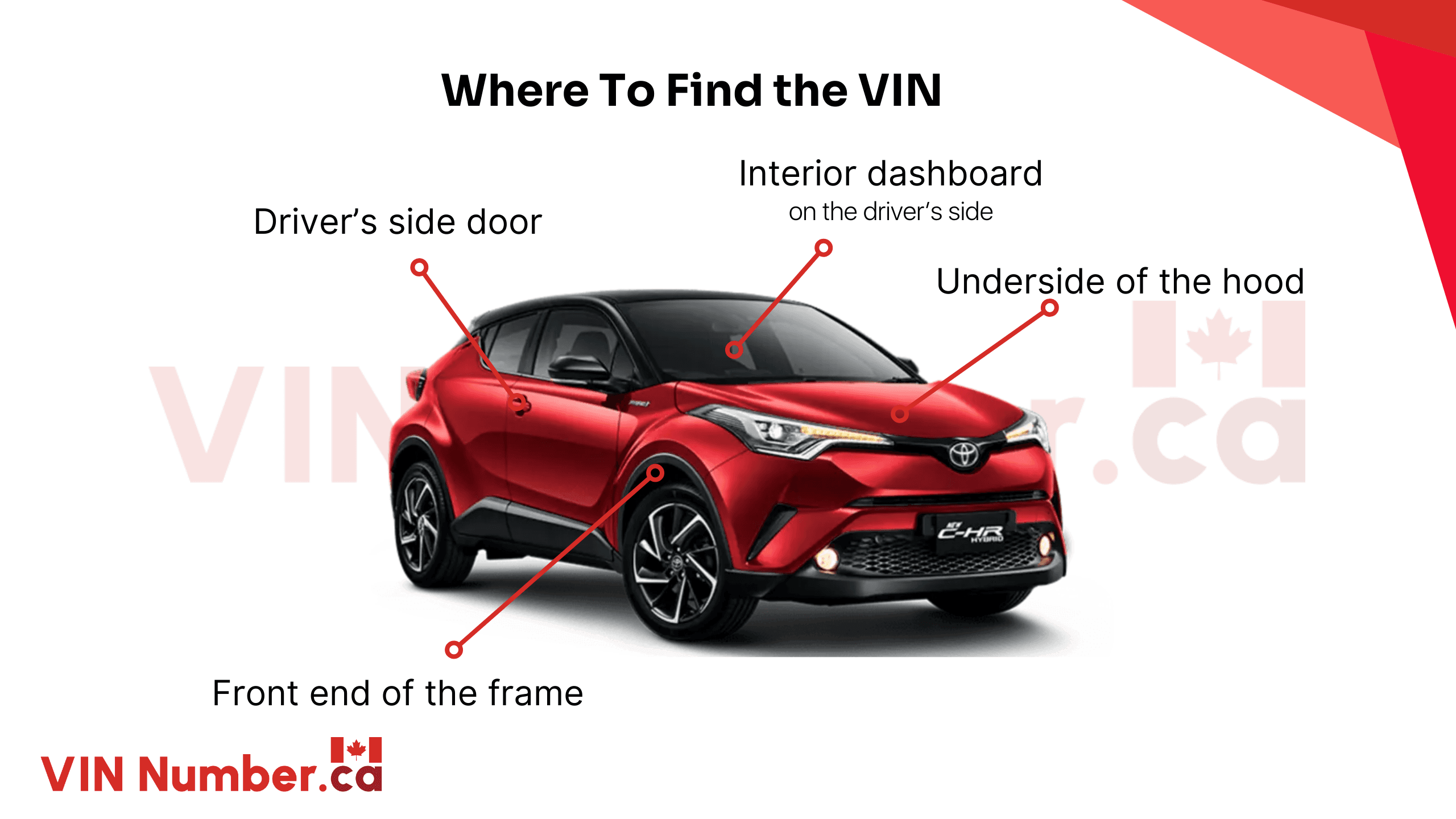
Locate the VIN
Find the 17-digit VIN on your vehicle; it’s typically located on the dashboard (visible through the windshield) or on the driver’s door jamb.
Fill in the Form
Enter the VIN on the form above, then click on the search button to begin the search.
Get the Report
Wait for a few seconds to get the report generated. Examine the preview report and proceed to payment to receive the full vehicle history report.
Where Can I Find the VIN Number?
To find the VIN number, you can examine the registration report or the owner’s manual. Otherwise, if you want to get the VIN from the vehicle’s body, examine these parts:
Windshield Area
At the bottom corner of the windshield on the driver’s side, visible from outside.
Driver’s Door Frame
On the doorframe or doorjamb on the driver’s side.
Under the Hood
Stamped on the engine block.
Vehicle Paperwork
In documents such as the owner’s manual or the registration paper.
VIN Anatomy Breakdown
A 17-digit VIN is divided into three parts: the WMI for the manufacturer, the VDS for the vehicle details, and the VIS for the serial number. Each section gives important information that helps you see the vehicle’s details.
World Manufacturer Identifier (Digits 1–3)
The first three characters make up the World Manufacturer Identifier (WMI). This section tells you exactly who built the car and roughly where it was built.
Digit 1 (Geographic Area)
Identifies the region of the world where the vehicle was assembled, such as '1', '4', or '5' for the United States, or '2' for Canada.
Digit 2 (Manufacturer)
Identifies the specific manufacturer, often corresponding to the name of the company, like 'G' for General Motors or 'B' for BMW.
Digit 3 (Vehicle Type/Division)
When combined with the first two digits, this final WMI character often specifies the vehicle type (like a truck or passenger car) or the manufacturing division within a corporation.
Vehicle Descriptor Section (Digits 4–8)
The middle section, consisting of five digits, is known as the Vehicle Descriptor Section (VDS). These characters detail the specific characteristics of the vehicle model. This is where you confirm things like the body style and engine.
Digits 4–8
These positions vary significantly by manufacturer but generally specify the vehicle's features, including the model line, series, body style, engine type, and restraint system (airbags).
Check Digit (Digit 9)
The ninth character is called the Check Digit, and its sole purpose is to detect fraudulent or improperly recorded VINs. The check digit must match the result of that formula; if it doesn't, the VIN is invalid or has been tampered with. T
Vehicle Identifier Section (Digits 10–17)
The final eight characters form the Vehicle Identifier Section (VIS), which is unique to that specific vehicle. It details the car's assembly lineage and its serial number.
Digit 10 (Model Year)
This character indicates the vehicle's official model year. It uses a rotating code of letters and numbers (excluding I, O, Q, U, and Z).
Digit 11 (Assembly Plant)
This single character specifies the exact manufacturing plant where the vehicle was assembled.
Digits 12–17 (Serial Number)
The last six digits form the vehicle's production sequence or serial number. This number makes the VIN truly unique, differentiating your specific car from every other one of the same make, model, and year.
Laws Related to Alberta VIN Checks and Registration
Alberta’s Traffic Safety Act requires buyers to register vehicles in their name to get a new title and registration. Vehicles from other provinces must pass an Out-of-Province Vehicle Inspection before registration.
Alberta Insurance and Vehicle Registration
You cannot legally drive a vehicle on public roads in Alberta without valid insurance and a valid registration. The VIN is the link between the vehicle, your insurance policy, and the government’s registration records.
Proof of Valid Insurance
The "pink card" must be presented at the registry agent office, and the insurance policy must match the VIN of the vehicle being registered.
Vehicle Registration Certificate
The vehicle registration certificate issued by the province will permanently display the vehicle's VIN, serving as the official record of ownership and legal status. Please note that failure to register a vehicle or driving with an expired registration can result in significant fines and, in some cases, vehicle impoundment.
Don't Wait, Get Your VIN Report Now!
Access vehicle information sourced from a wide range of trusted Canadian and North American databases. Our reports are compiled using records from provincial registration agencies, insurance-related databases, vehicle auctions, theft and recovery records, and proprietary vehicle sales data, helping you make more informed decisions with confidence.
A VIN search gives you fast access to real history, including past accidents, title problems, odometer readings, and possible future repair costs. It only takes a few seconds to run, but it can save you thousands and prevent serious mistakes. Check the VIN now and make sure the vehicle is worth it.
FAQs on VIN Search Alberta
What is an Alberta VIN Search?
An Alberta VIN search uses the unique 17-character Vehicle Identification Number to get the vehicle report. You can easily obtain specifications and records like accidents, recalls, odometer readings, warranty status, maintenance history, and many more.
To use the Alberta VIN check, click on the form above and write down the VIN on the form. Remember, always run a VIN check before you sell or buy a used vehicle to ensure it matches your needs and close the deal faster.
How do I check a VIN number for free in Alberta?
To check the VIN for free in Alberta, you can use our Alberta VIN Search tool and get the basic information about the vehicle, like the year, make, model, country of origin, and market value of the vehicle. Note that to get a full history check, you need to make a payment.
Common Red Flags Found Through an Alberta VIN Lookup Process
Red flags in an Alberta VIN lookup include signs of VIN tampering, title problems like salvage or rebuilt status, a stolen record, major accident history, an odometer reading that doesn’t add up, or issues with liens and registration. These warnings often mean hidden damage or possible fraud.
Does Vinnumber.ca Alberta cover American cars?
Yes, you can use VINNumber.ca to decode American cars, even though you are living in Canada. As long as you have an American car, you can use our service to decode the VIN and get the vehicle history report, or to get the window sticker.
What Is a Vehicle Identification Number in Alberta?
A Vehicle Identification Number in Alberta is a unique 17-character code that identifies a specific vehicle. It shows details about the maker, features, and specs, and it is used for registration, insurance, recalls, and history checks.
You can find it on the dashboard, driver-side door post, registration papers, and insurance documents. For special cases, such as rebuilt or recovered vehicles, Alberta also offers an assigned VIN program through registry agents.
Is the Engine Number Different From the VIN?
Yes, the engine number is different from the VIN. The VIN is a 17-character code that identifies the whole vehicle, while the engine number is used only for the engine and is usually stamped on the engine block. They do not have to match, although some makers include part of the VIN in the engine’s serial code to help with tracking.
How Is a VIN Number Used in Alberta?
In Alberta, the VIN is important because it confirms a vehicle’s identity, helps track its history, and is required for registration and ownership transfer. It also helps check for theft, liens, accidents, and odometer issues. For custom-built vehicles, Alberta can assign a special VIN.
How Do I Check the Status of My Vehicle in Alberta?
To check a vehicle’s status in Alberta, look at the registration slip, sign in to your Alberta.ca account, or buy a Vehicle Information Report from a registry agent. The report uses the VIN to show liens, status updates, and past registration records.
Can You Track a Car by VIN Number in Alberta?
You can track a vehicle’s history and legal status using the VIN through a report, but you cannot use the VIN to track the vehicle’s real-time location or find the personal information of the current or previous owners. You can find non-protected, historical data like registration dates and locations, but it omits names, addresses, and licence plate numbers for privacy reasons.
What if I don’t find the information that I am looking for?
If the vehicle history report doesn't contain the detail you were expecting, perhaps a missing accident that you know occurred, it likely means the incident was either not reported to police, was settled out of pocket, or wasn't filed as an insurance claim. Remember, reports are only as good as the data provided to them.
Do you cover all vehicle makes and models?
Yes, because the VIN is a globally standardised code (for vehicles manufactured after 1981), any official VIN search system or history provider can decode the VIN and search the available records for virtually all passenger cars, light trucks, and SUVs.
Where does your data come from?
Our comprehensive reports, and the official Alberta VIR, pull data from several key trusted sources: the Alberta Motor Vehicle System (VIR), the Personal Property Registry Information System (PPRIS) for liens, police records (like CPIC), insurance claims data from the Insurance Bureau of Canada, collision facilities, salvage yards, and other provincial and state registries across North America. It’s a combined effort to give you the most accurate and layered history possible.